
Altovar content infrastructure

Keep content clear.Publish with confidence.

Write and organize pages, images and translations in one workspace. Review changes, then send them to the website you already use.

From the first idea to the next release.

SchemaAdminPublish

Your content. The tools you already work with.

RESTGraphQLTypeScript SDKAstro loader

THE WORKSPACE

A little structure. A lot of possibility.

Give every page, collection and language a place to grow.
Osprey CMSTHE WORKSPACE
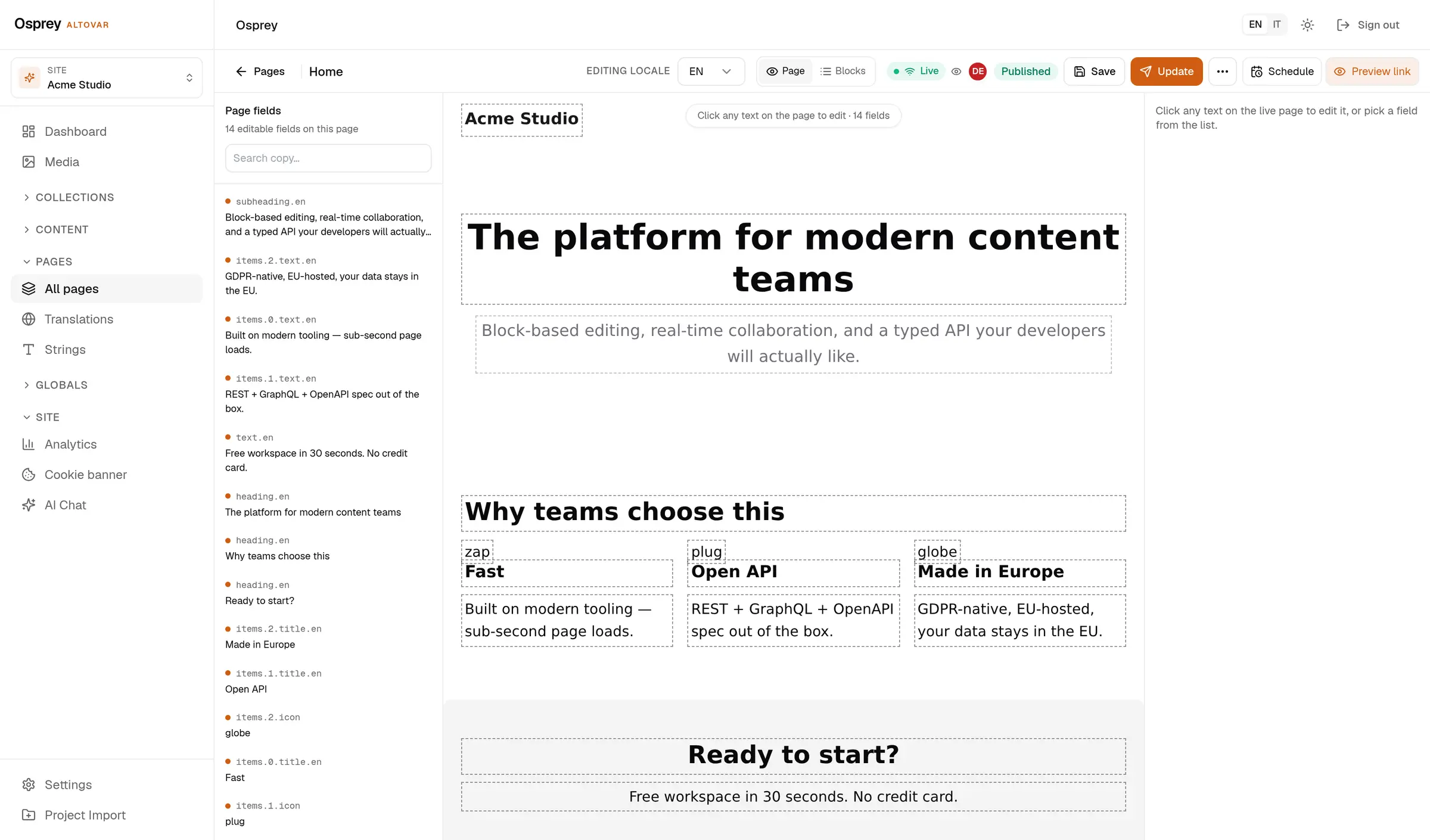
The Osprey admin editing a published page in place: the live page in the middle with fourteen editable fields outlined, the field list on the left, the locale selector and the Publish button in the toolbar.
The Osprey visual editor, captured in a demo workspace.

MADE FOR YOUR CONTENT

Everything in its place. Everything in your hands.

A clear workspace from the first field to the published page.

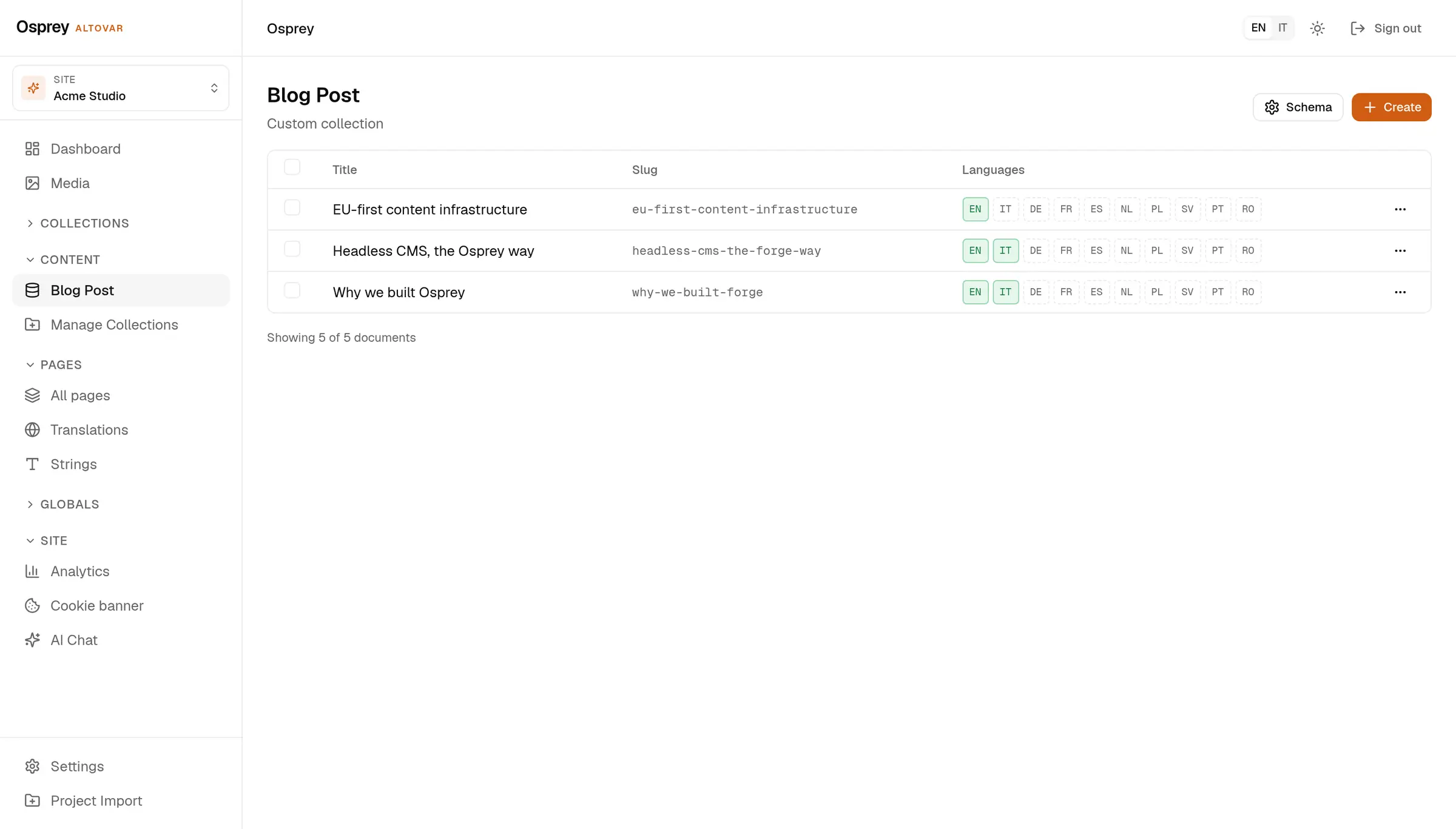
The Blog Post collection in the admin: three documents with title, slug and a coverage chip for each of the ten locales, EN and IT filled in.

01Schema

The schema is the form.

Slug, fields, access rules. It lives in your repository and goes through review like any other code.

How it works
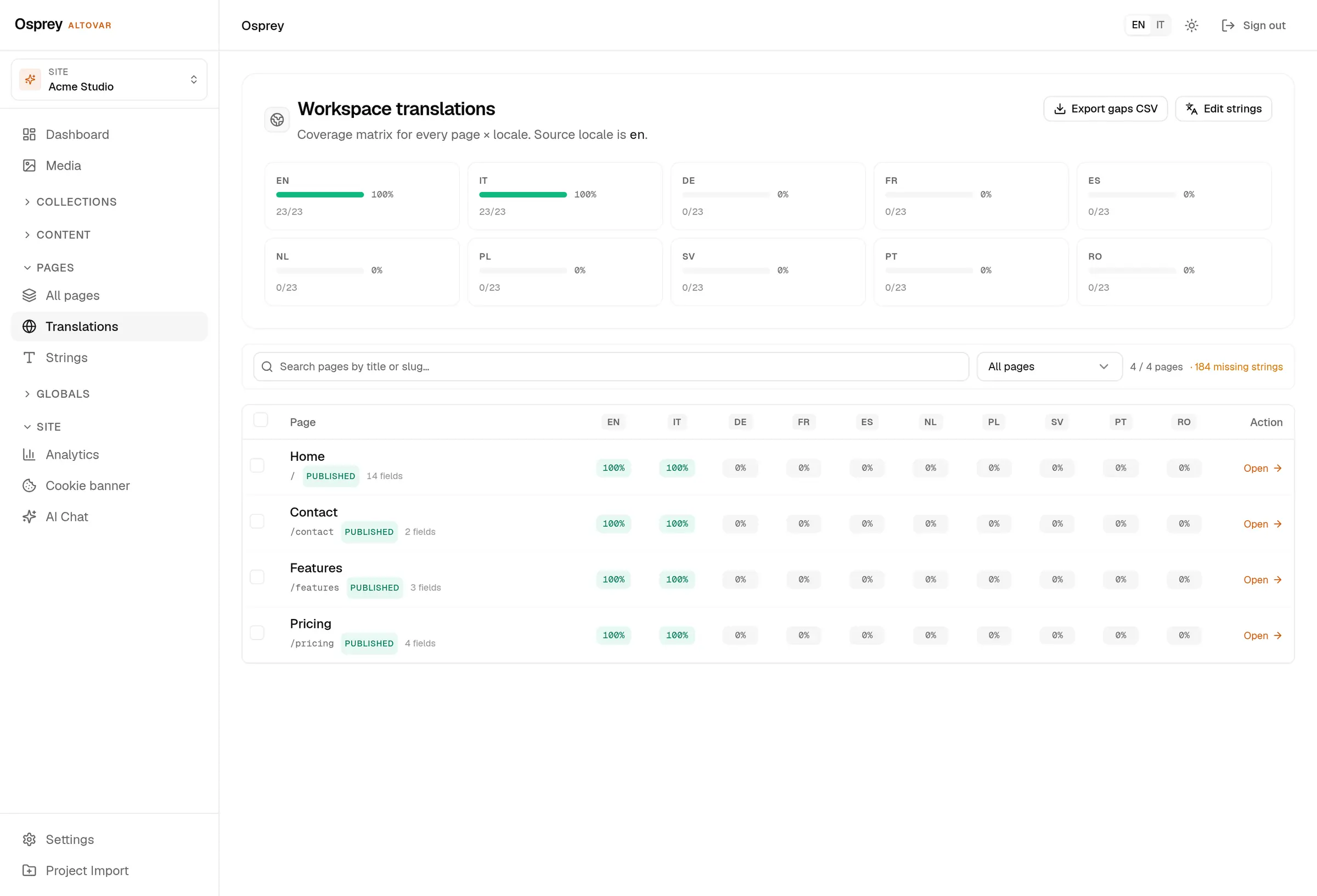
The workspace translations page: ten locale cards with coverage bars, EN and IT at 100 percent, and a per-page matrix below.

02The languages

Ten languages, one matrix.

Every localized field, every locale, counted.

Use cases
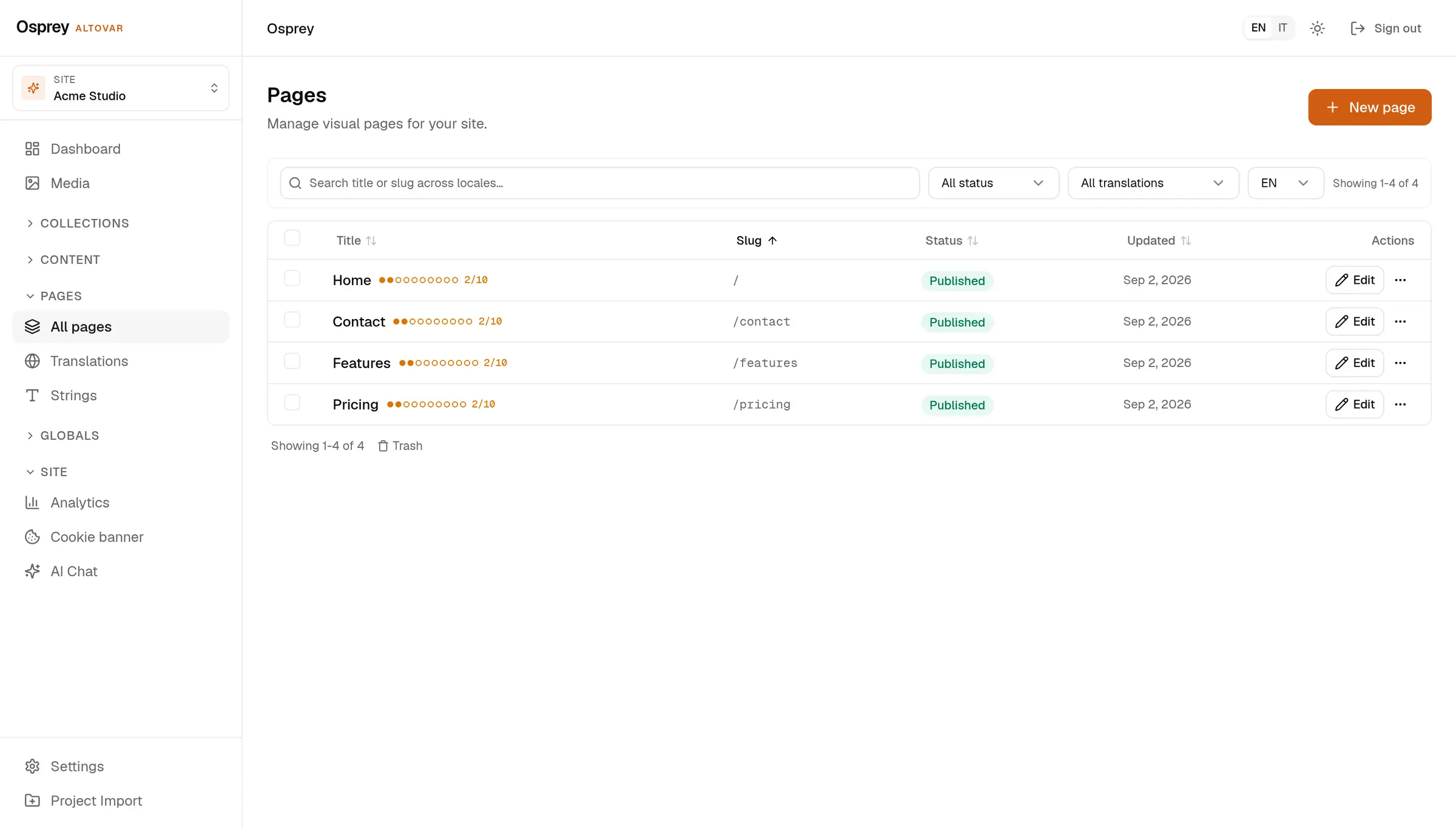
The pages list in the admin: Home, Contact, Features and Pricing, each with its status, its slug and a ten-dot translation coverage.

03Revisions

Publish here, appear there.

Pages support drafts, review, approval and scheduling. Page revisions include a diff and restore action, so you can inspect previous versions.

Features
HOW IT WORKS

From an idea to a page. One connected flow.

Define it once. Give your team room to create.
The Blog Post collection in the admin: three documents with title, slug and a coverage chip for each of the ten locales, EN and IT filled in.
Schema
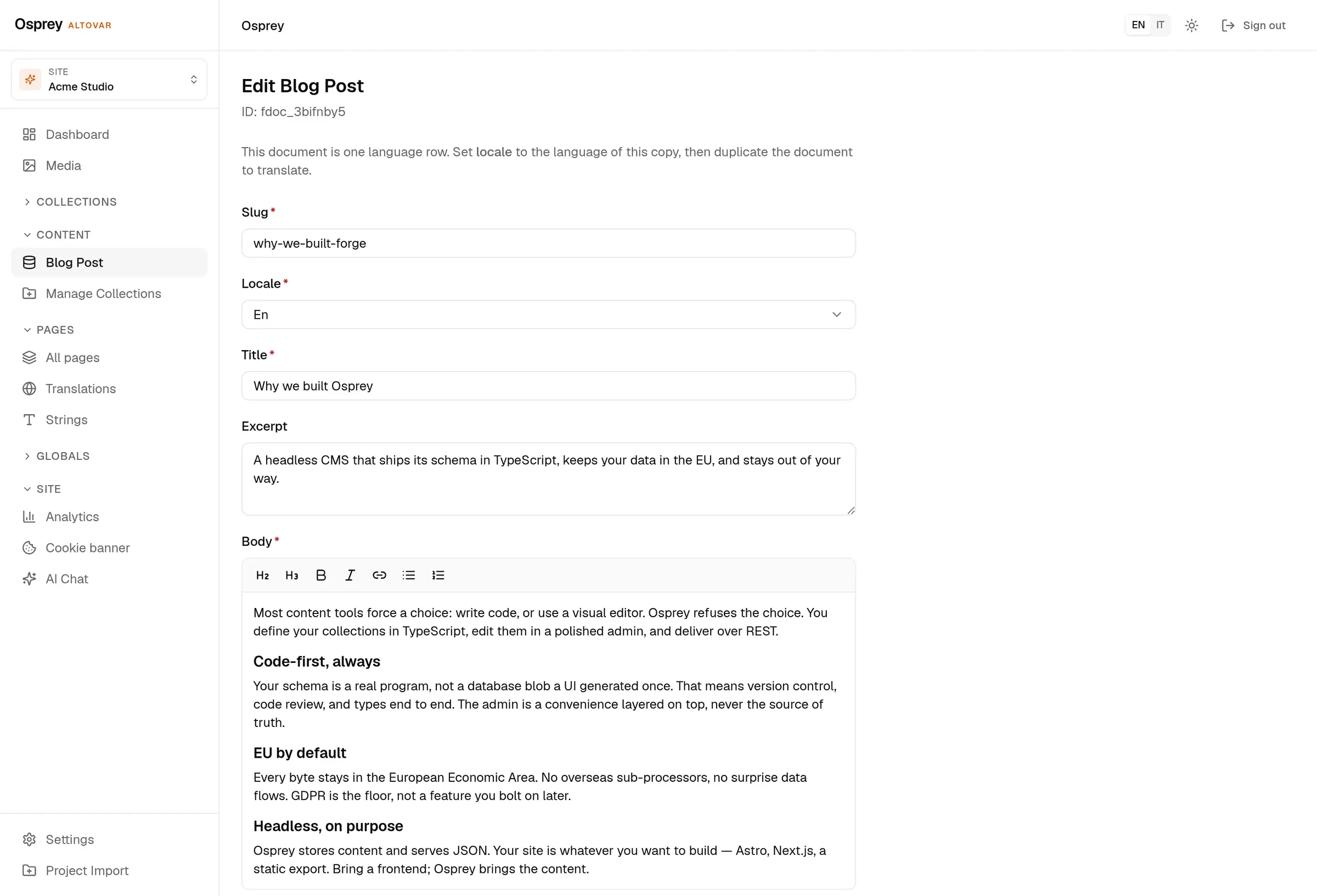
The document editor for a blog post: slug, locale, title, excerpt and a rich-text body with a formatting toolbar, drawn from the collection schema.
Admin
The pages list in the admin: Home, Contact, Features and Pricing, each with its status, its slug and a ten-dot translation coverage.
Publish here, appear there.
You define the collection in TypeScript.

Slug, fields, access rules. It lives in your repository and goes through review like any other code.

The admin reads the schema and draws the form.

Required fields, the locale selector, the rich-text body. Nothing is configured twice.

Publish here, appear there.

Pages support drafts, review, approval and scheduling. Page revisions include a diff and restore action, so you can inspect previous versions.

BUILT AROUND YOU

Different teams. The same creative freedom.

A workspace that fits the way you bring content to life.

The Blog Post collection in the admin: three documents with title, slug and a coverage chip for each of the ten locales, EN and IT filled in.

Your stack. Your way.

Keep your frontend and connect it through REST, read-only GraphQL, the TypeScript client or the Astro loader.

  • REST
  • GraphQL
  • Astro loader
The workspace translations page: ten locale cards with coverage bars, EN and IT at 100 percent, and a per-page matrix below.

More creating. Less coordinating.

Edit pages visually, move drafts through review and keep translations together in one workspace.
  • Revisions
  • Coverage
  • Three statuses
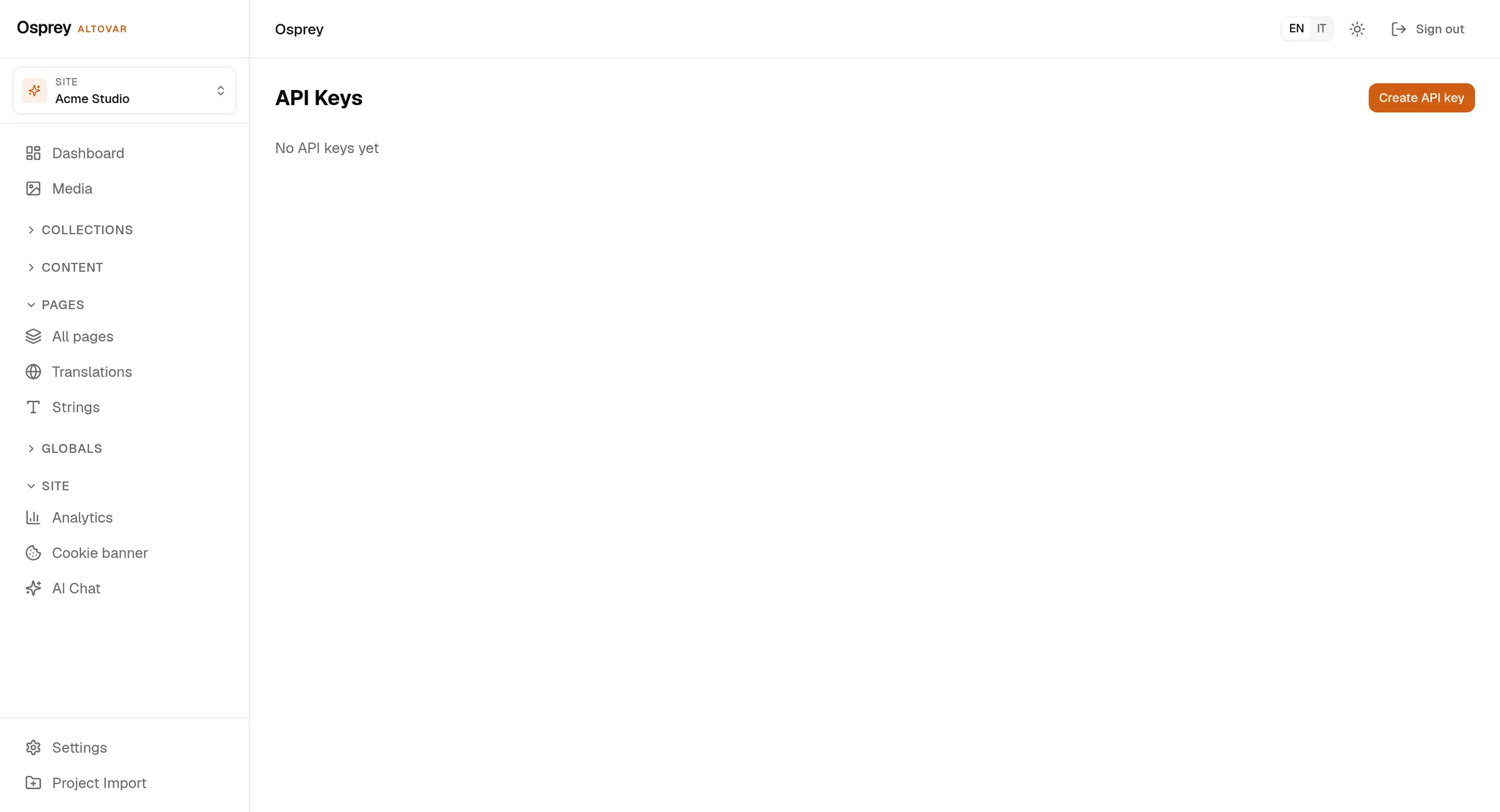
The API keys settings: one key labelled Default, its preview reduced to the last four characters, with the read-only flag and the creation date.

Make room for your next project.

Start with an existing schema, work across sites and give each person the access their role needs.

  • Roles
  • Start from a real project.
  • Sign-in

THE FOUNDATIONS

Small details. Room to build.

10
content languages in one workspace
4
ways to read your content
EU
hosted in Europe, or on your servers

Pricing

Pay for scale, not for seats.

Every plan includes the full CMS, the APIs and ten languages. Upgrade when you outgrow the limits.

Osprey Free

Freewithin plan limits

Block editor, REST + GraphQL API, 10 languages, community support.

Start free
Pages
25
Users
3
Media storage
1 GB
  • Block editor
  • REST + GraphQL API
  • 10 languages

Osprey Headless

€9.00/ month14-day free trial

CMS and API only: no renderer or hosting included, bring your own frontend.

Get started
Pages
250
Users
10
Media storage
25 GB
  • REST + GraphQL API
  • Bring your own frontend
  • Webhooks
  • Email support
Hosting add-on

Hosting, per site.

Provisioned on Altovar Cloud. Requires an Osprey base plan.

  • Hobby€5.00/ month
  • Starter€15.00/ month
  • Pro€45.00/ month
  • Business€120.00/ month
Your infrastructure

Your infrastructure. Your rules.

Run Osprey on your own servers with the self-host stack and the first-run setup wizard.

Talk to us

A FEW ANSWERS

Good questions. Clear answers.

A little more about the way Osprey works.

What can I manage with Osprey?

Pages, articles, collections and media. Define your fields in TypeScript or create a collection from the admin, then edit content in the workspace.

Can I keep my existing website?

Yes. Osprey manages the content while your website keeps its design and technology. Connect the two through REST, read-only GraphQL, the TypeScript client or the Astro loader.

How does multilingual content work?

Osprey plans include ten content languages. Choose which fields need translation and use the coverage view to find missing text. The admin interface is available in English, Italian, German, French and Spanish.

Can I review changes before publishing?

Pages support drafts, review, approval and scheduling. Page revisions include a diff and restore action, so you can inspect previous versions.

Can I host Osprey myself?

Yes. Use the self-host stack on your own infrastructure, or choose managed hosting in Europe. Ask us to help you choose the right setup.